
Ulysse Rancon - Homepage
I am a 3rd year PhD student in computational neuroscience and artificial intelligence. My research is interdisciplinary and at the frontiers between neuroscience, deep learning, computer science and neuromorphic computing. I like to take high-level descriptive/quantitative approaches that fit real data well (as deep neural networks usually do), and analyze the latter rather than the other way around.
Background 
Originally from an electrical engineering and signal processing background, I have always been fascinated by the brain, among other complex systems. After a very fruitful experience in an academic research lab at the University of Tokyo which made me discover neuromorphic electronics, I honed my deep learning skills in the industry at Bull. From my Master’s thesis on event-based sensors and AI at the Brain and Cognition Research Center (CERCO) in Toulouse, I went on to do a PhD in computational neuroscience -a position that I’m still holding today.
Current Work and Projects 
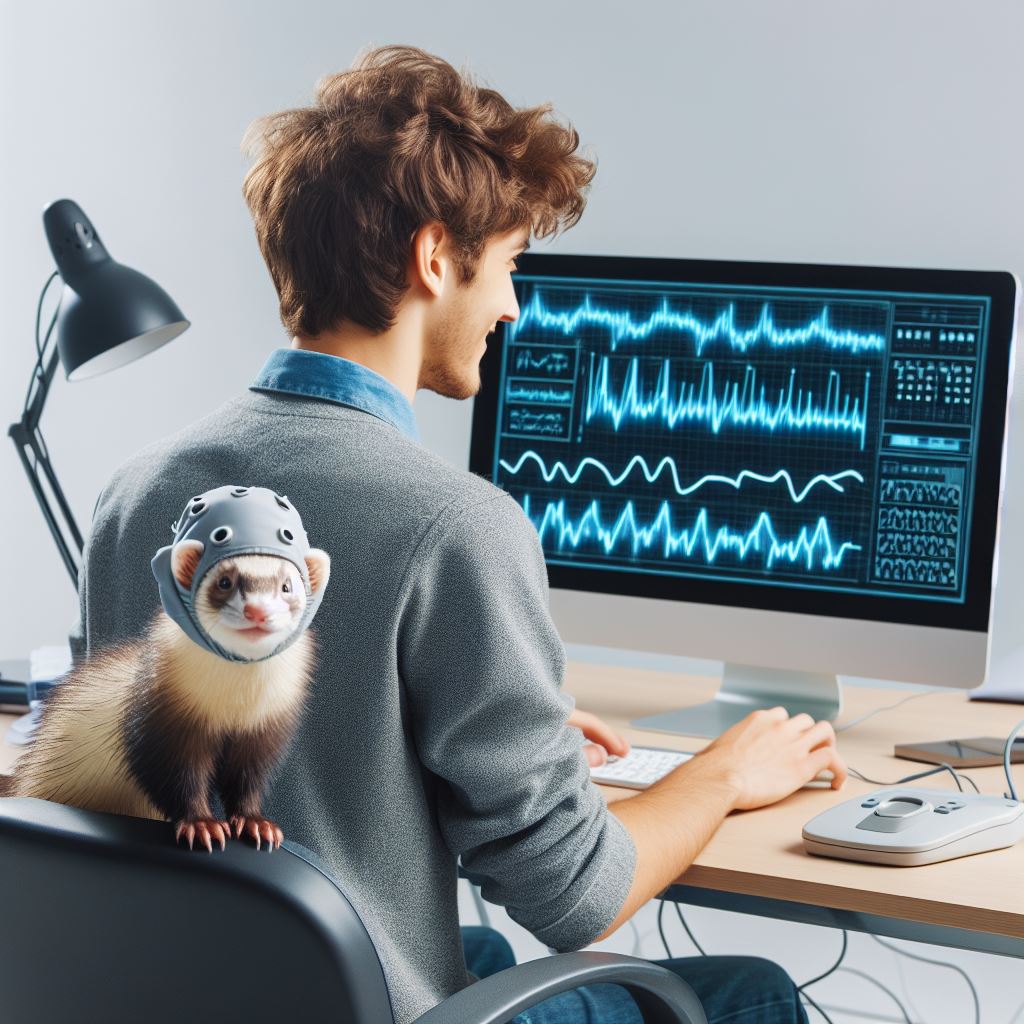
My PhD focuses on using deep neural networks trained with backpropagation as models of the brain, sensory neurons in particular. Experimenters present sounds/videos to live animals implanted with electrodes, and record the simultaneous activity of single units in response to these stimuli. As a modeller, I feed the latter as inputs to my models and expect them, through training, to output a predicted activity that would resemble as close as possible what has been actually recorded. By doing so, one is replacing a real neuron by an in-silico model -an abstraction that we can play with to our liking. For example, it allows us to predict what the response to a new sound would be. Furthermore, reverse-engineering accurate and inacurate models could help us unravel how neurons compute. Finally, a downstream application potentially enabled by this kind of modeling could be that of neural prosthetics for rehabilitation.
Ethics / Animal Experimentation Statement 
I cannot thank enough the electrophysiologists that share their precious and extremely expensive data to the community on public repositories. When we think about it, everybody is winning: by doing so, they give precious work material to theorists who in turn cite them back. Most importantly, new animals don’t get to die “unnecessarily” to get some data that has been already acquired but never shared. Contrary to what one would think, lots of neurophysiological data is readily available on websites such as the excellent CRCNS. So let’s wonder what quantities are sleeping in local hard drives in labs around the globe. In this current era of deep learning and data-driven approaches, I am certain that great progress in neuroscience is yet to come, supposing the community shares its fruits and normalizes its practices. Let’s do it for the sake of science, or at least that of our animal friends, without which any of that would not be possible.
Future Research Interests 
As passionate as I may be about the subject of my current thesis, I have many other ideas inside my bucket list! Here are a few:
- a data-driven deep spike sorter
- towards BCIs (closed loop electrophysiology)
- a compact AI based model of C. Elegans and Drosophiliae (both have a completely mapped connectome now)
- …
And in quite distant fields:
- computational modeling of crowd behavior (see Mehdi Moussaïd’s work
- communicating with animals with deep learning (there are some very cool groups and papers working on this topic)
- …
Other interests 
Interculturality is as important in my life outside the lab than interdisciplinarity is for my research. This is why I am always very curious about other cultures, with a bias towards Asia so far. I can’t help but love far-East Asia’s aesthetics, cuisine, and teas ! Aside from traveling, languages are a great and fun way to dive into other countries, and they never fail to fascinate me.